

Recommended Discounts

Where Winds Meet
This Top Up service is not applicable to Playstation User.
20% OFF
Related articles


Where Winds Meet Crafting Guide: Beat Fatigue & Flip Goods
Where Winds Meet's crafting economy runs on two systems: artisan stamina management and strategic market flipping. Your stamina pool caps at 2,500 points, restores 450 daily at 04:00 PM UTC-5, and co-op trade sales yield up to +300% value. Three items rotate weekly price peaks around Wednesday. Master both systems and you've got one of the most consistent silver-generating loops in the game.
Buffget
Understanding Artisan Fatigue: The Core Mechanic
Stamina Costs by Craft Type
All disciplines draw from the same 2,500-point shared pool:
- Construction: 1–2 stamina per item
- Manual crafting: 1–7 stamina per item
- Forge (Blacksmithing): 2–10 stamina per item
- Cook: 3–8 stamina per item
- Brew (Alchemy): 4–12 stamina per item
Daily Reset Rules
Stamina restores 450 points daily at 04:00 PM UTC-5 — a fixed increment, not a full refill. Starting from zero, reaching 2,500 takes roughly six days of passive recovery. You can't binge-craft for a week and recover overnight. Multi-day planning is non-negotiable.
Pre-load Before Breakthrough Events
Stop spending stamina two to three days before any major crafting session or in-game event. With a 450-point daily cap, waiting until event day leaves you under-resourced. Pre-loading your pool is the single highest-leverage habit you can build.
Stamina Management: Maximizing Daily Output
Rank by Profit-Per-Stamina, Not Item Price

Crafting the most expensive item is a beginner trap. Brew costs up to 12 stamina per item. If a brewed item yields only marginally more silver than a manual craft at 1–7 stamina, the manual craft wins every time. This adjustment alone can increase effective daily output by 20–40% without changing your playtime.
Daily Rotation Structure
- Construction crafts first (1–2 stamina) — fulfill guild and housing obligations at minimal cost
- Manual crafts next (1–7 stamina) — steady mid-tier items with reliable demand
- Forge or Brew last — only when market prices justify the higher stamina cost
Check prices before committing stamina to high-cost disciplines. Burning your pool on Brew items before confirming market support is the most common efficiency killer.
Guild Base & Infrastructure
Reach Guild Level 3 to unlock Xiangqi and additional activity options. Rent a house in Kaifeng, upgrade your warehouse, and check local boards regularly. These foundational steps expand storage and surface local price data — both essential for high-volume operations.
Identifying the Best Goods to Flip
The Weekly Price Window
Three items rotate weekly with fluctuating prices, peaking around Wednesday. Weekends show no meaningful fluctuation.
Timing rule: Scout rotating items Monday–Tuesday. If material costs are low and the item trends upward, craft and list before Wednesday's peak. Don't list these items Saturday or Sunday — flat market, maximum competition.
Note: selling commodities to NPCs in other players' worlds becomes available starting Wednesday, aligning perfectly with the weekly peak.
Co-op Sales: The +300% Multiplier
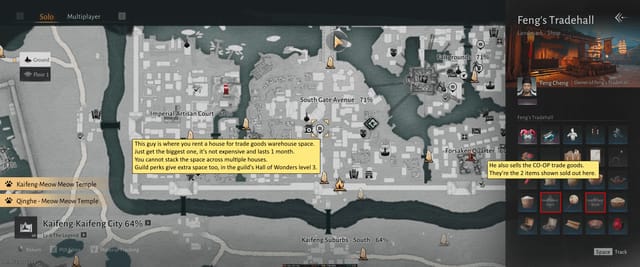
This is the largest value multiplier in the game's economy:
- Co-op trade goods: +300% value vs. standard NPC sales
- Co-op world sales: +250–300% value
The trade process:
- Purchase goods in your realm
- Enter a player realm to sell
- Deliver the goods
- Complete the quick challenge
The Trade Commission handles all trade goods transactions. Primary hubs: Feng Chen's Tradehall in Qinghe and Kaifeng.
Daily Material Sourcing
Two daily-limited materials to buy every single day:
- Raw ore: 99 daily
- Coarse fur: 99 daily
Skip this and you'll be buying at inflated market prices during high-demand windows — a direct margin killer. Also: merchant commodities from Kaifeng NPCs are available Saturday and Sunday, making those days optimal for material acquisition even though they're poor days for selling finished goods.
For players funding larger material purchases ahead of weekly windows, buy Where Winds Meet coins securely through buffget — competitive pricing, fast delivery, secure transactions.
The Crafting Economy Math
Core Profit Formula
Before spending any stamina, verify this equation:
Net Profit = Co-op Sell Price − Material Cost − Transaction Fees
Then divide by stamina cost to get profit per stamina point. The item with the highest ratio wins your queue slot — every time.
Commerce Coins: Uncapped Revenue
Commerce Coins have no weekly cap, making them a reliable parallel income stream. Sources:
- Selling trade goods locally or through co-op
- Selling captured horses
- Pitch-pot wagers
- Mahjong wagers
- Other minigame wagers
Small Boxes of Commerce Coins are available in the Season Shop and Meow Meow Temple Shop for direct purchase.
For context on capped currencies:
- Jade Fish: caps at 20,000 weekly
- Hundred Trades Treasure Coins: caps at 2,500 weekly from Hundred Trades activities and the Career system
Hit those caps before investing more time in those sources. Commerce Coins compound — capped currencies don't.
Step-by-Step Flip Execution
- Monday–Tuesday: Scout the three rotating weekly items. Check material costs and price trends.
- Daily: Buy 99 raw ore and 99 coarse fur from NPC sources before anything else.
- Pre-craft: Calculate profit-per-stamina for your top three candidate items.
- Craft in rotation: Construction and Manual first, higher-cost disciplines only when margins justify.
- List 12–24 hours before Wednesday's peak — not on the day of, to capture early buyers.
- Starting Wednesday: Sell commodities to NPCs in other player worlds for the co-op multiplier.
- Reinvest Commerce Coins into Season Shop boxes and materials to sustain the loop.
Commodity Arbitrage: The Stamina-Free Flip
When your stamina pool is depleted, pivot to commodity arbitrage — buy from one location, sell to another for profit. No stamina required. Use the Horseman Lantern for trade goods transport. It's not glamorous, but it keeps silver flowing when crafting is offline.
Mistakes That Kill Your Profit
- Buying materials at market price — always source raw ore and coarse fur from daily NPC limits first
- Ignoring stamina cost differentials — a 12-stamina Brew craft is not the same as a 1-stamina Construction craft
- Weekend listings on fluctuating items — no price support, maximum competition
- Skipping co-op sales — selling locally when co-op yields +300% leaves most of your revenue on the table
- Scaling before confirming demand — craft one or two units first, confirm sell speed, then batch
Advanced Tips: Scaling Up
Patch Windows
The 48–72 hours after a major patch are the highest-volatility window in the market cycle. Players with pre-stocked materials and stamina can list into price spikes before supply catches up. Review patch notes specifically for changes to stamina values, material sources, and co-op trade mechanics — these three variables shift your profit calculations most.
Know Your Daily Silver Ceiling
Daily ceiling = stamina pool ÷ average stamina cost × average net profit per craft
Once you've hit that number, switch to stamina-free activities: commodity arbitrage, minigame wagers, Commerce Coin farming. When a market oversaturates — falling prices, unsold inventory piling up — pivot to a different item category immediately. Don't race to the bottom on price.
Pro tip: the Where Winds Meet top up center cheap at buffget is worth bookmarking for funding material purchases ahead of high-demand windows, with strong user ratings and reliable delivery.
Frequently Asked Questions
What is artisan fatigue in Where Winds Meet? A stamina cost applied per craft action. All disciplines share a 2,500-point pool. Costs range from 1–2 (Construction) to 4–12 (Brew). Restores 450 points daily at 04:00 PM UTC-5.
How do I recover stamina quickly? You can't — there's no instant recovery. Stamina restores passively at 450/day. Stop spending two to three days before high-priority sessions to rebuild your pool.
What happens when stamina hits zero? Crafting stops entirely until the daily restore ticks. This is why rotation and prioritization matter — burning your pool on low-margin crafts before high-value windows is the costliest mistake in the economy.
When's the best time to sell crafted goods? List the three weekly fluctuating items before Wednesday's peak. Avoid weekend listings — no price fluctuation, high competition. Co-op sales starting Wednesday offer the +300% value multiplier.
Are Commerce Coins worth farming? Yes. No weekly cap means they compound meaningfully over time. Pitch-pot, Mahjong, horse sales, and Season Shop boxes all contribute. Prioritize these over capped currencies once you've hit those weekly limits.
Is crafting more profitable than combat farming? With co-op trade sales at +300% value, crafting beats combat farming on a per-hour basis — provided you manage stamina efficiently. The advantage is predictability. The constraint is the stamina ceiling limiting daily volume.