

Recommended Discounts

Arena Breakout Bonds
Arena Breakout Player ID is numerical!Tap in Personal Information center, your player ID can be found under the avatar.
10% OFF
Related articles


Arena Breakout Armor EHP: Ceramic Beats Titanium Math
EHP = Base Durability ÷ (1 + Absolute Burn Rate). The KN Field Commander's (ceramic) delivers 53 EHP from 80 durability at -2 burn rate. The BT6 Heavy (titanium) yields only 30 EHP from 90 durability at -6 burn rate. Ceramic averages 58% post-raid durability vs. titanium's 34%, costs 150 Koen per EHP vs. 488 Koen for BT6, and lasts 8–12 raids vs. titanium's 4–6. The math consistently favors ceramic. Titanium's value is situational.
Buffget
What Is EHP — And Why It Beats Raw Durability
Raw durability is one of Arena Breakout's most misleading stats. An armor showing 90 durability doesn't absorb 90 damage. Effective Hit Points (EHP) — the actual damage absorbed before armor fails — is the calculation that matters.
Armor doesn't absorb damage at 1:1. Each hit burns durability at a rate determined by material type and ammo. High durability with a brutal burn rate gets stripped faster than lower durability with a gentle one. EHP is the only honest comparison tool.
The formula: EHP = Base Durability ÷ (1 + Absolute Burn Rate)
Burn rate is per-hit durability loss as an absolute value. -2 burn = 2 durability per hit. -6 burn = 6 per hit. Dividing base durability by (1 + burn rate) gives total hits before failure.
Blunt damage is the secondary layer — even stopped rounds transfer impact force through as trauma. Material type affects passthrough percentage, so two armors with identical EHP can still produce different survivability outcomes depending on ammo type.
Why Same Durability ≠ Same EHP
BT6 Heavy: 90 durability, -6 burn rate → 90 ÷ 7 = ~30 EHP KN Field Commander's: 80 durability, -2 burn rate → 80 ÷ 3 = ~53 EHP
The KN absorbs 77% more effective damage with 10 fewer raw durability points. That's the core insight.
For players funding smarter gear cycles without grinding Koen endlessly, cheap Arena Breakout global currency is available through buffget — built for fast, secure in-game currency delivery.
Ceramic Armor: Stats, EHP, and Repair Math
Ceramic dominates Tier 5 because its low burn rate preserves durability across multiple hits, translating directly into superior EHP.
Tier 5 Ceramic Options
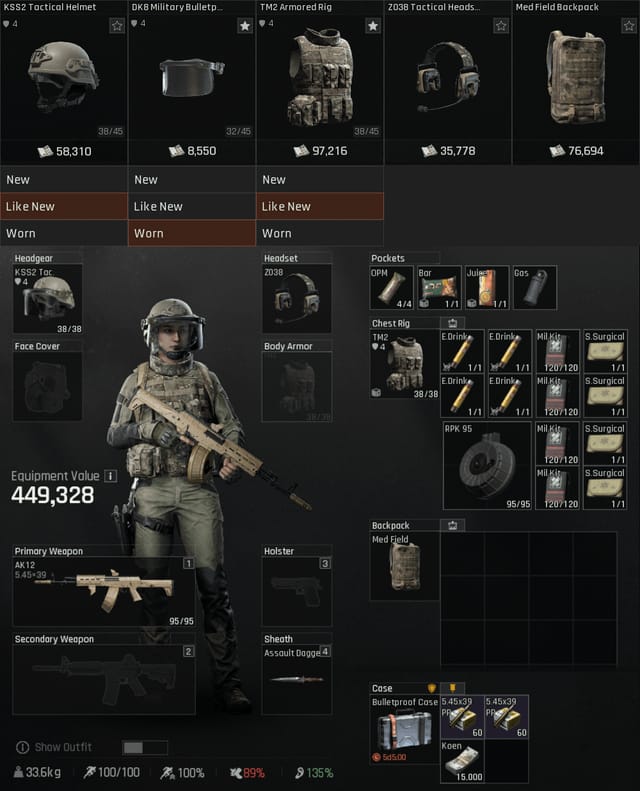
- KN Field Commander's: 80 durability, -2 burn rate, -5% movement, 5.7kg, thorax coverage
- H-LC Tactical: 70 durability, -1 burn rate, -5% movement, 5.9kg, thorax coverage
- 926 Synthetic: 70 durability, -3 burn rate, -4% movement, 6.2kg, thorax coverage
Tier 6 Ceramic Options
- BT101 Tactical Body Armor: 100 durability, -4% movement, 5.5kg, chest
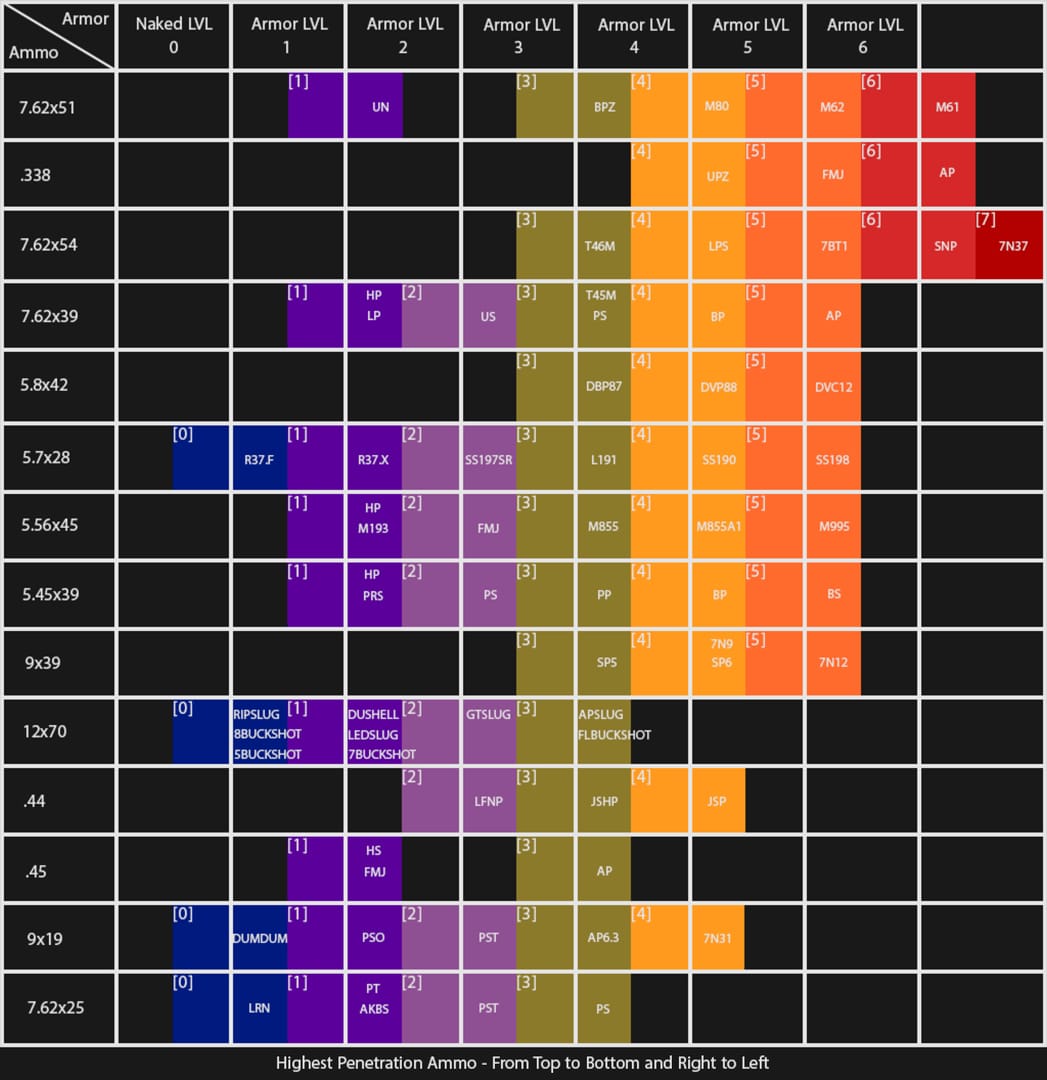
- KN Composite Body Armor: 110 durability, -7% movement, 6.9kg, chest + upper abdomen
- Marshal Heavy Body Armor: 115 durability, -12% movement, 7.8kg, chest + shoulders + upper abdomen
T5 ceramic burn rate range of -1 to -2 is the critical differentiator. Against standard ammo: 1–2 durability per hit. Against AP rounds: 2–3 per hit — still far below titanium's degradation profile.
Ceramic Repair Economics
- Supports 3–4 repair cycles before replacement
- Repair cost: 500 Koen per durability point
- Average post-raid durability: 58% (KN Field Commander's exits at ~46 durability, needing ~34 points restored = ~17,000 Koen per repair)
- Per-raid repair cost: 12,000–18,000 Koen
- Full lifecycle cost: 96,000–216,000 Koen across 8–12 raids
- Cost per EHP: 150 Koen
Ceramic Durability Protection Bands
- Above 70%: Full protection
- 50–70%: Moderate protection
- 30–50%: Compromised
- Below 30%: Liability — don't trust it
Ceramic's 58% average post-raid durability keeps it in the moderate-to-full band for most raids. You're rarely entering engagements with compromised armor without realizing it.
Titanium Armor: Stats, EHP, and Repair Math
Titanium offers higher raw durability paired with aggressive burn rates that consume it fast. Know this before spending 120,000 Koen on a BT6.
Key Titanium Options
- BT6 Heavy (T5): 90 durability, -4 burn rate (-6 effective in high-intensity engagements), -6% movement, 8.6kg
- KN Defender L3 (T3): 70 durability, -5 burn rate, -6% movement, 6.2kg
- KN Assault L3 (T3): 50 durability, -6 burn rate, -3% movement, 5kg
The -4 to -6 burn rate range is titanium's defining liability. Against AP rounds, titanium faces 15–25 durability loss per hit — a single AP burst can strip a BT6 from full protection to liability in 2–3 hits.
Titanium Repair Economics
- Supports 1–2 repair cycles before replacement
- Repair cost: 800 Koen per durability point
- Average post-raid durability: 34% (already in compromised/liability territory)
- Per-raid repair cost: 22,000–35,000 Koen
- Full lifecycle cost: 88,000–210,000 Koen across only 4–6 raids
- Cost per EHP: 488 Koen
How Titanium EHP Collapses After One Repair
BT6 at baseline: 90 ÷ 7 = ~30 EHP
After Repair 1 (realistic max drops to 76 durability): 76 ÷ 7 = **22 EHP** — a 27% reduction after a single cycle.
After Repair 2 (titanium's practical maximum): EHP drops below 20. The armor's class rating is still technically active, but it's delivering false confidence, not genuine protection.
And the movement penalty compounds things further. BT6's -6% movement + 8.6kg vs. KN Field Commander's -5% + 5.7kg means you're slower, heavier, and burning through armor faster.
EHP Side-by-Side: Ceramic vs. Titanium Across the Full Lifecycle
At Full Durability (New Armor)
- KN Field Commander's (Ceramic T5): 53 EHP
- H-LC Tactical (Ceramic T5): 35 EHP
- BT6 Heavy (Titanium T5): ~30 EHP
- KN Defender L3 (Titanium T3): ~11.6 EHP
- KN Assault L3 (Titanium T3): ~7 EHP
Even at baseline, the KN Field Commander's outperforms the BT6 by 77% — at 85,000 Koen vs. 120,000 Koen. That's 41% lower purchase price for dramatically superior protection.
After Repair Cycle 1
Ceramic max durability drops ~5–8%. Titanium drops ~10–15%.
- KN Field Commander's:
75 effective max → 75 ÷ 3 = **25 hits** - BT6 Heavy:
76 effective max → 76 ÷ 7 = **10.8 hits**
Ceramic retains approximately 2.3x the effective hit count after the first repair.
After Repair Cycles 2 and 3
Titanium typically hits replacement threshold at cycle 2. BT6 EHP drops to 18–20 — its final usable state.
Ceramic at cycle 2 still delivers 40–45 EHP. At cycle 3, ceramic is still outperforming what titanium provided at baseline.
EHP Across the Full Lifecycle (Summary)
At 100% max durability (new):
- Ceramic T5: 53 EHP | Titanium T5: 30 EHP
At ~75% max (post-Repair 1):
- Ceramic T5: ~40 EHP | Titanium T5: ~22 EHP
At ~50% max (post-Repair 2):
- Ceramic T5: ~26 EHP | Titanium T5: ~15 EHP
At ~25% max (end of lifecycle):
- Ceramic T5: ~13 EHP (replace now) | Titanium T5: ~7 EHP (well past threshold)
Ceramic delivers more EHP at every lifecycle stage, at lower cost per EHP, across more total raids.
The Repaired Armor Is As Good As New Myth — Debunked
This assumption kills players who think they have protection they no longer possess.
Why the Durability Bar Lies After Repairs
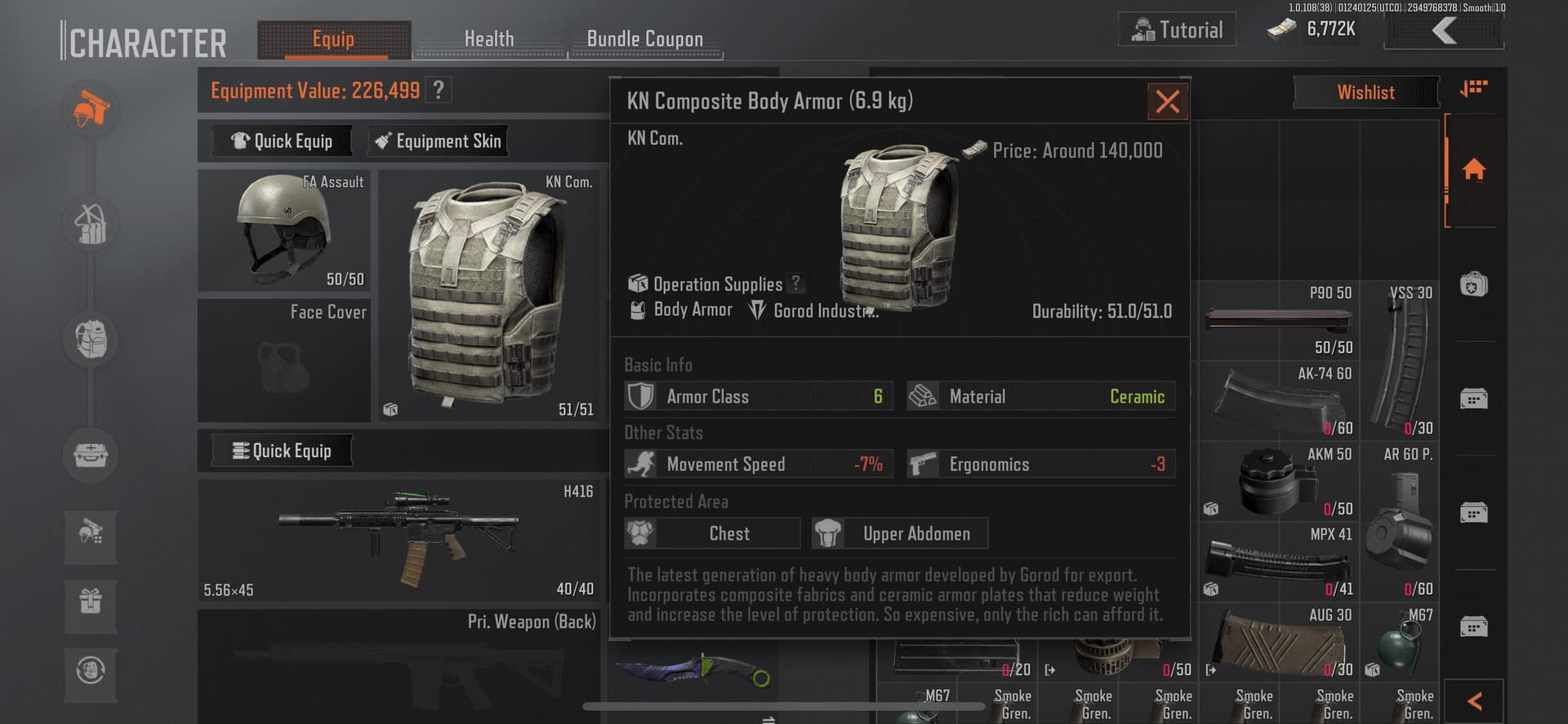
The durability bar shows current durability as a percentage of the current maximum — not the original. An armor repaired twice with a new max of 65 durability shows 100% when fully repaired to 65. But EHP is calculated against that reduced ceiling.
A fully repaired armor can be operating at 60–70% of original EHP while the UI shows it as pristine.
Real Scenario: 3x-Repaired Ceramic Failing When It Shouldn't
A KN Field Commander's through three repair cycles degrades from 80 to ~55–60 effective maximum. EHP drops to roughly 18–20 — comparable to a fresh T3 titanium piece. Against AP ammo at 2–3 durability burn per hit, it fails in 18–27 hits instead of the original 26+. The player thinks they have T5 protection. They have T3 performance.
Replace T5 armor when it drops below 40% of original maximum durability.
What Experienced Players Actually Check
Before deploying repaired armor:
- Absolute maximum durability value — not the percentage bar, the actual number in detailed stats
- Number of previous repair cycles — tracked manually or inferred from the gap between original and current max
- EHP at current maximum — run the formula before high-stakes raids
- Protection band status — confirm above 70% of current maximum before entry
The bar is a convenience indicator. The formula is the truth.
Repair Kits: How Efficiency Determines Post-Repair EHP
Repair kit efficiency directly sets how much EHP you recover. This isn't a minor optimization.
How Efficiency Percentage Works
An 80% efficiency kit applied to 20 lost durability restores 16 points — the remaining 4 become permanent maximum durability loss. This compounds across cycles.
Ceramic repaired 3x with a low-efficiency kit vs. a high-efficiency kit: the difference can exceed 15–20 EHP across the full lifecycle.
Ceramic vs. Titanium: Which Kit to Buy
For ceramic (3–4 repair cycles): Invest in premium kits. The extra Koen is recovered through extended lifecycle — more raids, lower amortized cost per raid.
For titanium (1–2 repair cycles): Standard kits are often the rational choice. A premium kit on a BT6 that hits replacement threshold after one more raid regardless doesn't justify the premium.
Premium vs. Standard Kit Math
For ceramic across 3 cycles:
- Standard kit (70% efficiency): ~30% permanent loss per cycle → ~20 durability lost by cycle 3
- Premium kit (90% efficiency): ~10% permanent loss per cycle → ~7 durability lost by cycle 3
EHP difference at cycle 3: 6–8 effective HP — translating to 2–4 additional hits absorbed. In extraction gameplay, those hits are the difference between extracting and dying 50 meters from the exit.
Economy Analysis: Cost-Per-EHP Across the Full Lifecycle
Ceramic (KN Field Commander's)
- Purchase price: 85,000 Koen
- Repair cost: 500 Koen per durability point
- Per-raid repair: 12,000–18,000 Koen
- Lifecycle: 8–12 raids
- Total lifecycle cost: 96,000–216,000 Koen
- Cost per EHP: 150 Koen
Titanium (BT6 Heavy)
- Purchase price: 120,000 Koen
- Repair cost: 800 Koen per durability point
- Per-raid repair: 22,000–35,000 Koen
- Lifecycle: 4–6 raids
- Total lifecycle cost: 88,000–210,000 Koen
- Cost per EHP: 488 Koen
BT6 costs more than 3x ceramic's rate per effective HP. Hard to justify for regular raid cycles.
The Crossover Point: New Ceramic vs. Repairing Old Titanium
At titanium's second repair cycle:
- Twice-repaired BT6: ~15–18 EHP remaining
- Fresh KN Field Commander's: 53 EHP
- Cost gap: ~50,000–63,000 Koen
For 50,000–63,000 additional Koen, you gain 35–38 EHP and reset to a full 8–12 raid lifecycle. Buy new ceramic instead of repairing titanium a second time. The math is unambiguous.
For players who want loadouts fully stocked without interruption, Arena Breakout Bonds fast recharge through buffget offers competitive pricing and rapid delivery.
Practical Decision Guide: When to Run Ceramic, When to Run Titanium
Choose Ceramic When:
- Budget per raid is under 30,000 Koen
- Running 3+ consecutive raids in a session
- Facing primarily standard ammunition
- Prioritizing mobility and weight management
- Armor is at or below 50% of original maximum durability
Pro tip: The H-LC Tactical (70 durability, -1 burn rate, 35 EHP) is the strongest budget option — low repair cost, excellent mobility, solid EHP.
Choose Titanium When:
- Entering high-value zones with confirmed AP ammunition threats
- Armor class rating is the primary survival variable for that specific threat environment
- Budget allows 22,000–35,000 Koen per-raid repair costs
- Running single high-stakes raids rather than sustained sessions
Titanium's value is class-dependent, not material-dependent. If you need its class rating to stop specific rounds, the premium may be justified. If you're buying it for higher raw durability numbers, you're using the wrong metric.
Replace Rather Than Repair When:
- Ceramic drops below 40% of original maximum durability
- Titanium reaches its second repair cycle
- EHP calculation shows T5 armor delivering T3-equivalent performance
- Post-raid durability consistently exits below 30% (liability status)
FAQ: Arena Breakout Armor Material Math
Q: What is EHP in Arena Breakout and how is it calculated? EHP = Base Durability ÷ (1 + Absolute Burn Rate). KN Field Commander's: 80 ÷ 3 = 53 EHP. BT6 Heavy: 90 ÷ 7 = 30 EHP. It's the actual hits absorbed before armor fails — not the raw durability number.
Q: Is ceramic or titanium better in Arena Breakout? Ceramic wins in most scenarios: 150 Koen per EHP vs. 488 Koen for BT6, 8–12 raid lifecycle vs. 4–6, 58% average post-raid durability vs. 34%. Titanium is only preferable when armor class rating is the primary survival variable against specific AP threats.
Q: How does repairing armor reduce EHP? Each repair permanently reduces maximum durability ceiling. A 70% efficiency kit loses 30% of repaired durability permanently. Since EHP is calculated from maximum durability, a lower ceiling directly reduces EHP. After 3 cycles with standard kits, ceramic can lose 15–20 EHP from its original value.
Q: How many times can you repair ceramic armor before it's worthless? 3–4 cycles. By cycle 4, compounding maximum durability reduction typically degrades EHP to T3-equivalent levels despite the T5 class rating. Replace when it drops below 40% of original maximum durability.
Q: Does armor class override material type for EHP? No — they're separate variables. Armor class determines which ammo types are stopped. EHP determines how many hits before failure. A T5 ceramic and T5 titanium stop the same rounds, but ceramic delivers 77% more EHP. Both matter; neither overrides the other.
Q: Is it worth repairing armor or buying new? Ceramic: repair through cycles 1–3, then replace. Titanium: repair once, then strongly consider buying new ceramic instead of a second titanium repair. The crossover point — where new ceramic beats repaired titanium on both EHP and lifecycle cost — hits at titanium's second repair cycle.