

Recommended Discounts

Bigo Live Diamonds
Top up Bigo Live Diamonds in seconds! Just enter your Bigo Live user ID, select the value of Diamonds you wish to purchase, complete the payment, and the Diamonds will be added immediately to your Bigo Live account.
47.57% OFF
Related articles


Bigo Live Family Battle Strategy: Win PKs & Rewards
Master Bigo Live Family Battle strategy with this comprehensive guide. Learn precise PK timing, shield mechanics, reward splitting formulas, and resource allocation to dominate the leaderboard and maximize diamond returns.
Buffget
Why Family Battles Matter for Diamond Growth
Family Battles are the core competitive engine of Bigo Live, determining hierarchy and driving significant diamond flow between agencies. Victory isn't just about prestige; it directly impacts your family's treasury and individual member earnings. Winning consistently unlocks higher-tier badges, attracting wealthier supporters and active hosts. This creates a feedback loop: visibility leads to more diamonds, which fuels more victories.
Families that master the mechanics of Combat Points (CP) and reward splitting see sustainable growth. Those relying solely on brute force spending often burn out. To maintain a competitive edge, many families utilize Bigo Live diamonds top up services to ensure diamond reserves never run dry during critical moments.
Mechanics: Agency vs. Host Battles
Understanding the difference between Agency and Host battles is the first step toward dominance. Agency battles typically involve larger teams and higher stakes, whereas Host battles focus on individual broadcaster performance.
Official vs. Friendly PKs:
- Official PKs: Last 5-10 minutes. Pace your resource expenditure over the longer duration.
- Friendly PKs: Last 3-5 minutes. Adopt an aggressive burst strategy immediately.
Pro Tip: Identify your battle type before starting. Ensure your team understands the time limit so they don't hold back resources until it's too late.
Eligibility Requirements
Participation is gated by family size and administrative levels. Verify these before recruiting to avoid disqualification.
- Season 1 & Season 3: Minimum 5 members required.
- Season 2 & Season 4: Minimum 7 members required.
- Creation Requirement: Account Level 10+.
Action Plan: If you are in S2 or S4, prioritize recruiting at least 2 active members beyond the S1 minimum. Ensure your Family Admin is Level 10+ to create the structure.
Pre-Battle Preparation & Recruitment
A family's structural integrity limits its operational capacity. Families can have a maximum of 100 members, but effective management requires a smaller, elite core of active senders.
Recruitment Strategy:
- Quality over Quantity: Focus on dedicated contributors rather than filling slots.
- Scout Examples: Look at successful families like Daniels Fam (ID: 77733) and PRIME Fam (ID: 15030).
- Commitment: New members should stock 50,000-100,000 coins pre-PK to ensure readiness.
- Peak Hours: Recruit members who can commit to 7-10 PM. This timeframe boosts engagement by 60%.
Preparation Steps:
- Audit your member list. Remove inactive users to free up slots.
- Practice with 3-5 minute Friendly PKs to test coordination.
- Use the Family ID search to scout top performers in other families.
- Offer clear reward splitting policies upfront to attract high-value members.
Essential Resources: Diamonds and Budgeting
Resource allocation determines the sustainability of your war chest. PK battles typically consume 50,000-100,000 coins per session.
Budgeting Guidelines:
- Per Session: 50,000-100,000 coins.
- Monthly Shield Budget: 10,000-25,000 beans.
Managing a monthly shield budget requires careful planning. Using a reliable platform for Bigo Live recharge can significantly reduce operational costs while maximizing value. Secure transactions and competitive pricing allow families to stretch their diamond supply further across more battles.
Strategic Use of Multiplier Cards & Shields
Battle cards and shields provide the necessary leverage to overcome stronger opponents.
Costs & Stats:
- Light Shields: 1,500-2,500 beans.
- Emergency Shields: >10,000 beans.
- Gift Amplification: 1.5-2.0x multiplier on sent gifts.
Execution Tactics:
- Shield Timing: Deploy shields 5-7 seconds before the PK ends to block last-minute opponent surges.
- Card Timing: Use amplification cards during the final 60 seconds when 40-50% of gifts are allocated.
- Cost Control: Avoid using expensive Emergency Shields unless the victory bonus (5-15% of battle gift value) justifies the cost.
Execution: How to Dominate the PK
Timing is the single most critical factor in securing a win.
The Snipe Strategy:
- Timing: Send gifts 2 seconds before the PK ends.
- Success Rate: This method results in an 85-90% success rate for registering points.
- Coordination: Coordinate a synchronized attack where all members send high-value gifts exactly at the 2-second mark.
Budget Allocation:
- First 60 Seconds: Allocate only 20-30% of your total gift budget.
- Final 60-90 Seconds: Reserve the bulk (40-50%) for the finale.
- Early Game: Avoid sending large gifts early unless necessary to trigger a winning streak bonus.
Coordinating Members via Voice Chat
Synchronized attacks outperform uncoordinated spending. Multi-guest streams allow up to 12 streamers to participate, creating a complex communication environment.
Best Practices:
- Shot-Caller: Designate a single person to dictate shield usage and attack timing.
- Channels: Use a separate voice channel to avoid lag.
- Roles: Define roles clearly. Are you the sniper (last-second sender) or the support (early-game point generator)?
The Math Behind Winning: Points and Multipliers
Understanding the point economy prevents wasted resources.
Core Formulas:
- 1 Bean received = 1 Combat Point.
- 1 Diamond sent = 1 Combat Point.
Tactical Adjustments:
- Cost-Per-Point: Calculate this before sending gifts.
- Shield Response: If an opponent uses a shield, pause sending immediately to avoid wasting diamonds on zero points.
- Rankings: Monitor rankings, which update every 15 minutes, to gauge your relative position and adjust spend rate.
Leveraging Winning Streaks
Consecutive victories provide psychological and statistical advantages. Families on a winning streak often deter challengers, reducing the frequency of defensive battles.
Defense Strategy:
- Protection: If you hold a lead, use Standard Shields (2,500-5,000 beans) to protect it rather than depleting diamond reserves on offense.
- Force Spend: Force opponents to expend resources to catch up.
- Reciprocity: A 30-40% gift reciprocity rate from opponents can be triggered by consistent, moderate gifting throughout the battle.
Bigo Live Family Battle Rewards: How They Work
The reward structure incentivizes consistent participation and high-value gifting.
Distribution Structure:
- Hosts: Retain 75% of their earnings.
- Family Pool: Shares 10-30% of gross post-host retention earnings.
- Top-tier pools: Share 20-30%.
- Mid-tier pools: Share 10-15%.
Action: Admins should tap the Family ID to access the Rewards tab and review the specific pool share percentage for their tier. Aim for top-tier status to maximize the family's cut of global revenue.
Payouts and Earnings
Payouts are governed by strict thresholds and schedules.
Key Dates & Rates:
- Payout Window: Monthly, between the 15th and 20th.
- Minimum Threshold: $50.
- Exchange Rates:
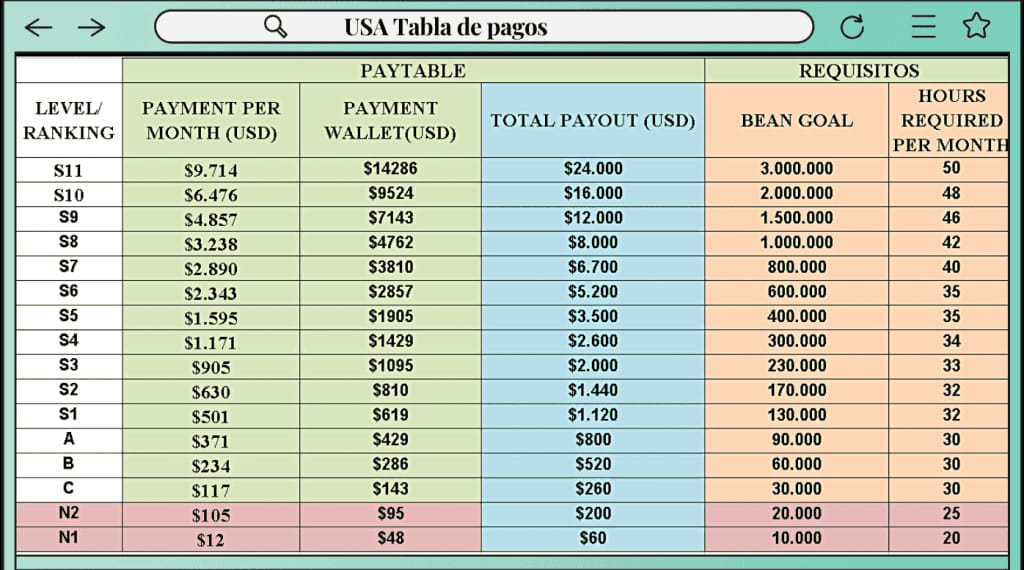
- 210 Beans = $1 USD.
- 286 Income Diamonds = $1 USD (Season 2).
Strategy: Track daily progress to ensure you meet the minimum payout threshold. Plan major battles for the end of the month to maximize the payout cycle.
Strategy for Fair Reward Splitting
Retaining top talent requires transparent and equitable distribution.
Splitting Model:
- High-Rebate PKs: Yield 50-85% Bean returns, which can be redistributed to active members.
- Tiered System: Members who contribute more diamonds receive a larger percentage of the victory bonus.
- Transparency: Publicly declare the splitting formula before the battle starts to prevent disputes.
- Tracking: Use the Treasury feature to log contributions automatically.
Advanced Tactics for High-Level Families
Long-term planning separates elite families from temporary contenders.
Future Planning:
- Major Events: The BIGO Awards Gala 2026 Family Tournament is confirmed for December 6-14, 2026. Build your roster and save resources specifically for this.
- Counter-Strategy: If an opponent consistently uses Heavy Shields (5,000-10,000 beans), prepare a counter-strategy involving rapid-fire small gifts to drain their shield efficiency.
- Analysis: Analyze opponent patterns by reviewing past battle histories.
Common Mistakes That Cost You the Battle
Poor resource management is the leading cause of defeat.
Avoid These Errors:
- Early Overspend: Do not spend 50% of your budget in the first minute.
- No Stockpile: Never engage without the minimum 50,000 coins stockpiled.
- Off-Peak Battles: Fighting outside 7-10 PM reduces potential engagement by 60%.
FAQ
How do you win a family battle in Bigo Live? Win by accumulating the most Combat Points. Send gifts 2 seconds before the PK end for an 85-90% success rate and deploy shields 5-7 seconds before the end to block opponent points.
How are rewards split in Bigo Live Family Battles? Hosts retain 75% of earnings. The Family Pool takes 10-30% of gross post-host retention earnings. Specific splits depend on whether the family is top-tier (20-30%) or mid-tier (10-15%).
What is the difference between Agency and Host battle? Official PKs last 5-10 minutes, while Friendly PKs last 3-5 minutes. Agency battles involve broader family strategy, whereas Host battles focus on individual streamer performance.
How many diamonds are needed for a Family Battle? Typically, battles consume 50,000-100,000 coins. It is recommended to stock this amount before starting. Shields can cost anywhere from 1,500 to over 10,000 beans.
What is the best strategy to win PK battles? Allocate 20-30% of gifts in the first 60 seconds and 40-50% in the final 60-90 seconds. Coordinate attacks during peak hours (7-10 PM) for a 60% engagement boost.
How long does a Bigo Live Family Battle last? Official PK battles last 5-10 minutes. Friendly PK battles are shorter, lasting 3-5 minutes.