

Recommended Discounts

SuperLive Coins
As the official partner of SuperLive, Buffget offers instant SuperLive Coins top up with fast delivery. Get up to 60% off on SuperLive Coins recharge via Buffget secure, convenient, and trusted by thousands.
20% OFF
Related articles


SuperLive Algorithm 2026: Hit Trending Page in 60 Min
Quick Answer: SuperLive's algorithm scores every stream on real-time viewer retention, chat density, and coin accumulation using a three-tier evaluation system. Trending eligibility activates after 60 minutes of sustained engagement — requiring 70% viewer retention at 10 minutes, 15–25 chat messages per minute, and consistent gift activity. Streams running 90–150 minutes with high interaction rates consistently outperform shorter, high-peak broadcasts.
Buffget
What Is the SuperLive Algorithm?
SuperLive's recommendation engine continuously evaluates every active stream and decides how widely to distribute it. It doesn't reward the most popular streamers — it rewards streams demonstrating strong content-audience fit through measurable behavioral signals.
The current three-tier framework launched September 12, 2025:
- Tier 1 (0–15 min): Initial audience sampling and early signal collection
- Tier 2 (15–60 min): Sustained engagement validation
- Tier 3 (60+ min): Trending promotion activation for qualifying streams
Each tier gates the next. Fail Tier 1 retention benchmarks and you won't receive Tier 2 distribution — regardless of how strong your content gets later.
Trending Page vs. Featured Page
The Trending Page is algorithmically driven — you earn placement through performance metrics. The Featured Page involves editorial curation and is far less predictable. Trending optimization is your primary controllable growth lever.
Why Algorithm Knowledge Beats Content Alone
Two streams of equal quality will have dramatically different outcomes if one is optimized for algorithm signals and the other isn't. Streams maintaining 50 engaged viewers for 90 minutes consistently outrank streams with 200 viewers and a 20-minute drop-off. That's counterintuitive — until you understand the scoring system.
The 6 Core Ranking Signals
Signal 1: Real-Time Engagement Rate
Target: 15–25 chat messages per minute with 30%+ unique chatters. The algorithm distinguishes between a handful of viewers spamming and a genuinely diverse, engaged audience. Reactions and shares contribute to reach amplification but carry significantly lower weight than coins.
Signal 2: Viewer Watch Time and Session Length
Retention benchmarks are specific:
- 70% retention at 10 minutes
- 50% retention at 30 minutes
- 35% retention at 60 minutes
- 25%+ completion rate triggers accelerated follower growth
Average session length matters more than peak concurrent viewers — this is one of the most misunderstood aspects of SuperLive stream ranking.
Signal 3: Gifts and Coins
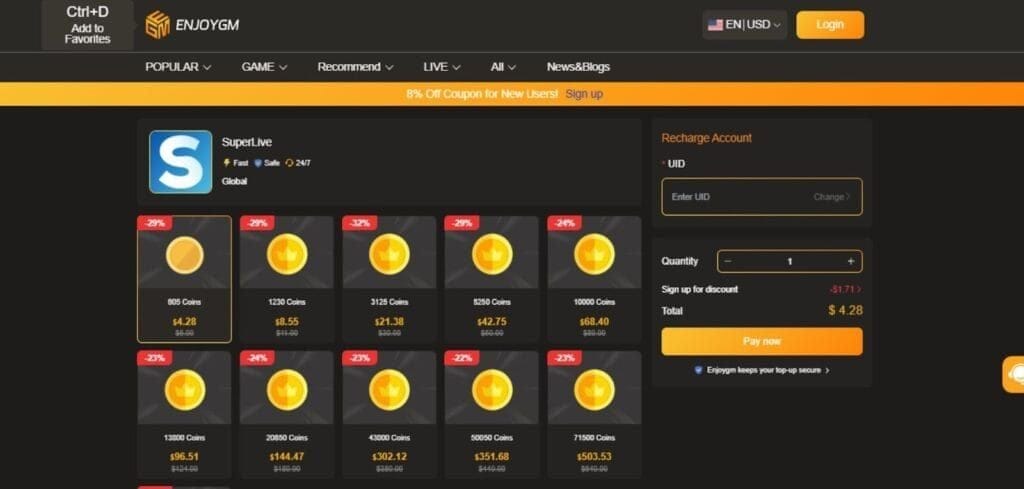
Coins carry 10–15x the algorithmic weight of likes or shares. That's not a minor advantage — it's a structural multiplier. Viral distribution triggers when a stream receives 10,000–20,000 coins within a 30-minute segment, making concentrated gift activity during peak engagement windows especially powerful.
To accelerate this, you can buy SuperLive coins top up through buffget — competitive pricing, fast delivery, and secure transactions that thousands of streamers use to fuel their growth strategy.
Signal 4: Consistency and Scheduling
Monthly requirements:
- Minimum 15 streaming hours across 12 separate broadcasts
- Maximum 3-day break between live streams
Irregular patterns signal low reliability to the recommendation engine, reducing proactive distribution even for high-quality content.
Signal 5: Profile Completeness and Category Relevance
Profile bios cap at 150 characters; profile pictures must be photos of the account holder. These aren't just community guidelines — they're trust signals the algorithm uses to assess account legitimacy. Accurately categorized streams get more targeted distribution than broadly categorized ones competing in oversaturated niches.
Signal 6: New Viewer Acquisition Rate
Streams where 40%+ of viewers contribute at least one interaction signal strong content-audience fit. This measures how effectively you convert passive viewers into active participants — a key indicator that influences ongoing distribution decisions.
SuperLive Engagement Score: How It's Weighted
The engagement score is a composite metric calculated in real time. Its components aren't weighted equally.
Chat vs. passive watching: Active chat participation carries significantly more weight than passive viewing. The 60% streamer response rate within 3 minutes requirement is critical — the algorithm tracks not just whether viewers chat, but whether you're creating a reciprocal interaction loop. Failing this window directly reduces your visibility score.
Reactions and shares: Lower algorithmic weight than coins, but they trigger immediate distribution to your viewers' social graphs — creating short-term viewer spikes that, if retained, feed back into the watch time signal.
Gift badge thresholds and their compounding effect:
- King badge: 10,000–20,000 coins
- Emperor badge: 90,000–120,000 coins
Badge events create visible social proof inside the stream, organically increasing chat activity and retention — compounding your overall engagement score.
How the Trending Page Algorithm Works
Eligibility Threshold
Trending promotion doesn't activate until after 60 minutes of sustained qualifying engagement. Streams under 60 minutes rarely trigger viral distribution — they never reach the evaluation tier where trending placement is assessed.
How SuperLive Compares Streams
The algorithm evaluates streams relative to others in the same category during the same time window. A smaller niche with strong engagement metrics can outrank a larger stream in a competitive category with weaker retention. Niche selection is a strategic decision, not just a content preference.
Why the First 10 Minutes Are Critical
The Tier 1 window (0–15 minutes) sets the trajectory for the entire broadcast. Fail the 70% retention benchmark at 10 minutes and you're algorithmically deprioritized before reaching Tier 2. Your opening segment must hook viewers immediately — not gradually.
Title, Tags, and Category Optimization
Titles: Accurately describe your content. Titles that match viewer expectations reduce early drop-off (protecting retention metrics) while matching search and browse intent within the recommendation engine.
Category: New streamers should avoid broad, high-traffic categories dominated by established accounts with longer algorithmic track records. Niche categories offer lower competition thresholds — easier to hit the relative engagement scores needed for trending placement during early growth.
Tags: Reflect the specific content of each broadcast, not generic popularity terms. The algorithm uses tags to match streams with viewers who've shown interest in similar content — accurate tagging directly improves new viewer acquisition rates (Signal 6).
The New Streamer Boost: How to Use It
New accounts receive elevated initial distribution — a temporary window designed to help the algorithm assess content-audience fit. Treat it as your highest-leverage growth period.
Actions that maximize the boost:
- Launch with a fully optimized profile (complete bio, verified photo)
- Stream the full 90–150 minute optimal duration from day one
- Coordinate viewer participation to hit chat density targets early
- Don't break the 3-day maximum gap during this period
Mistakes that waste it:
- Streaming under 60 minutes (never reaching Tier 3)
- Inconsistent scheduling
- Ignoring the 60% response rate requirement
Common Misconceptions
You need thousands of followers to trend. Follower count isn't a primary ranking signal. A new streamer with 50 highly engaged viewers can outperform an established streamer with 500 passive ones.
Going live more often always helps. Frequency matters only within the consistency framework. Streaming 20 times monthly with poor retention actively damages algorithmic standing. The 12-broadcast minimum is a floor — not a target to exceed at the expense of quality.
Gifts are only for monetization. Coins carry 10–15x the algorithmic weight of likes or shares. Gift events are among the most powerful ranking signals available, directly influencing viral distribution thresholds.
Stream quality doesn't affect rankings. Target 1080p at 4,500–6,000 kbps. Technical quality affects viewer retention, which feeds directly into the retention benchmarks driving tier progression. Front-facing camera, tripod, ring light, stable Wi-Fi — these aren't optional for competitive performance.
Your 7-Day Action Plan
Days 1–2: Setup
- Complete profile bio (within 150-character limit) with accurate, keyword-relevant content
- Upload a verified profile photo
- Select a specific niche category with moderate competition
- Configure stream output to 1080p at 4,500–6,000 kbps
- Build a 90–150 minute content structure with engagement triggers at the 10, 30, and 60-minute marks
Days 3–5: Engagement-First Streaming
- Open every stream with a high-energy segment engineered to retain 70%+ through the 10-minute mark
- Respond to chat messages — maintain 60% response rate within 3 minutes
- Prompt reactions, shares, and gift activity during peak engagement windows
- Hit 15–25 chat messages per minute through direct questions and interactive moments
Pro tip: To accelerate coin accumulation and hit viral distribution thresholds faster, the cheap SuperLive recharge center at buffget offers secure, fast top-up services with competitive rates and high user satisfaction.
Days 6–7: Analyze and Double Down
Track these five KPIs after every broadcast:
- 10-minute retention rate (target: 70%)
- 30-minute retention rate (target: 50%)
- Chat density (target: 15–25 messages/minute)
- Unique chatter percentage (target: 30%+)
- Viewer interaction rate (target: 40%+ contributing at least one signal)
Identify which segments produced the strongest retention and replicate those structures.
What Suppresses Your Reach
Behaviors that trigger reduced distribution:
- Streaming under 60 minutes consistently (never reaching Tier 3)
- Breaking the 3-day maximum gap between broadcasts
- Streamer response rate below 60% within 3 minutes
- Mismatching stream content with selected category
How inconsistency damages algorithmic standing: Accounts streaming consistently within the 12-broadcast monthly minimum accumulate algorithmic trust that translates into proactive distribution. Irregular patterns reduce organic reach even for high-quality content.
Signs your stream has limited reach:
- New viewer acquisition declining despite consistent content quality
- Chat density below 15 messages per minute despite an active community
- Streams not progressing past Tier 2 metrics
If these persist: audit technical setup first (stream quality, connection stability), then review scheduling consistency, then evaluate whether category selection is creating unnecessary competitive pressure.
FAQ
Q: How does SuperLive decide which streams go on the trending page? Trending promotion activates after 60 minutes of sustained engagement meeting specific benchmarks: 70% retention at 10 minutes, 50% at 30 minutes, 35% at 60 minutes, and 15–25 chat messages per minute. The three-tier framework (September 2025) gates trending access through sequential performance thresholds.
Q: Does SuperLive gift count affect trending ranking? Yes — significantly. Coins carry 10–15x the weight of likes or shares. Viral distribution triggers at 10,000–20,000 coins within a 30-minute segment, making concentrated gift activity one of the most powerful trending accelerators available.
Q: How many viewers do you need to trend? No fixed viewer count threshold exists. A stream with 50 engaged viewers sustaining 90 minutes of high-retention engagement outranks 200 viewers who drop off within 20 minutes. Engagement quality and retention consistency beat peak concurrent numbers every time.
Q: Why isn't my stream getting recommended to new viewers? Most common causes: failing the 70% retention benchmark at 10 minutes (blocking Tier 2 progression), streamer response rate below 60% within 3 minutes, streaming gaps exceeding 3 days, or stream duration under 60 minutes (never reaching Tier 3).
Q: How does the new streamer boost work? New accounts receive elevated initial distribution while the algorithm assesses content-audience fit. It's temporary — maximize it by streaming full 90–150 minute sessions, maintaining consistent scheduling, and hitting engagement benchmarks from your very first broadcast.
Q: Does streaming consistently help with the algorithm? Yes. The monthly requirement is 15 hours across 12 separate broadcasts with a maximum 3-day break between streams. Consistent scheduling builds algorithmic trust and increases proactive distribution — irregular patterns actively reduce organic reach regardless of content quality.